
The global energy storage systems market size was calculated at USD 266.82 billion in 2024 and is projected to surpas around USD 569.39 billion by 2034, expanding at a CAGR of 7.87% from 2025 to 2034.
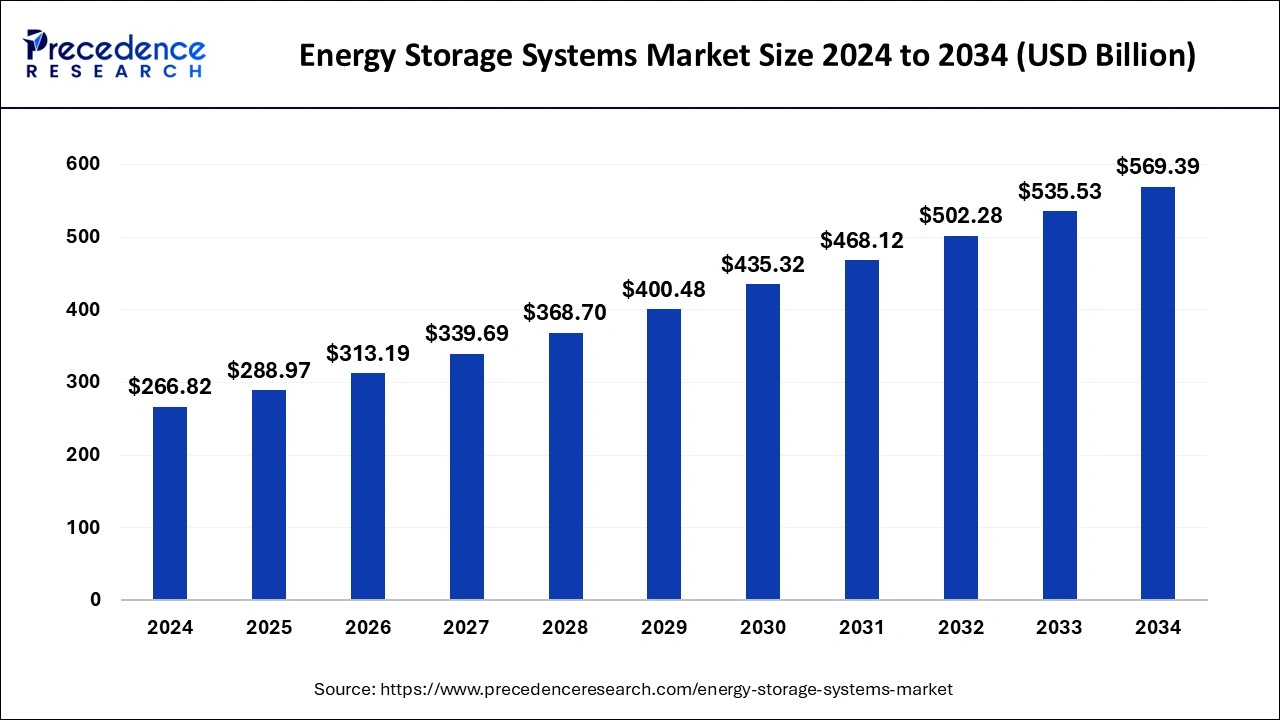
In terms of CAGR, the market is expected to expand at a notable annual rate of 7.87% from 2025 to 2034. Energy storage systems play vital roles in reducing peak demand, enhancing grid reliability, integrating renewable energy sources, resolving power outages, and in many other diverse applications, which raises the importance of advanced technology systems.
Key Stats at a Glance:
➢ Market size (2024): USD 266.82 billion
➢ 2034 forecast: USD 569.39 billion.
➢ CAGR (2025–2034): 7.87%.
➢ Largest region (2024): Asia Pacific (48% revenue share).
➢ Largest technology (2024): Pumped hydro (95.4% share).
➢ Fastest-growing technology: Electrochemical storage (14.2% CAGR, 2025–2034).
➢ Dominant application (2024): Grid storage; Transportation is projected to grow fastest.
➢ Base year / Forecast window: 2024 / 2025–2034.
Energy Storage Systems Market Overview
The energy storage systems refer to batteries utilizing smart energy management systems for charging and discharging as per the needs. This approach is effective in reducing the energy consumption of the grids. These solutions offer multiple users and devices in data retrieval from a centralized disk capacity. They are a crucial part of data management for enterprises of all sizes. They ensure the smooth and efficient operation of mass-storage devices. These power solutions simplify design and enable rapid deployment of large-scale and enterprise storage needs.
The major driving forces for the developments of renewable energy, such as wind power and solar energy, include the depletion of fossil fuels, the rise in energy demands, and concerns over climate change. The use of these solutions helps to improve the efficiency of energy storage utilization, which increases the use of renewable resources, increases energy access, and the electrification of the transportation sector. Nowadays, energy is stored using advanced methods and technologies, such as compressed air, molten salt, flywheels, thermals, and batteries.
Scope of Energy Storage Systems Market
| Report Coverage | Details |
| Market Size in 2024 | USD 266.82 Billion |
| Market Size in 2025 | USD 288.97 Billion |
| Market Size in 2030 | USD 435.32 Billion |
| Market Size in 2032 | USD 502.28 Billion |
| Market Size by 2034 | USD 569.39 Billion |
| Growth Rate (2025 to 2034) | CAGR of 7.87% |
| Leading Region in 2024 | Asia Pacific |
| Fastest Growing Region | Middle East & Africa |
| Base Year | 2024 |
| Forecast Period | 2025 to 2034 |
| Segments Covered | Technology, Application, End User, and Region |
| Key Technologies | Lithium-ion Batteries, Lead-acid Batteries, Flow Batteries, Thermal Storage, Flywheel, Compressed Air Energy Storage (CAES), Pumped Hydro |
| Key Applications | Grid Storage, Transportation, Residential, Commercial, and Industrial |
| Major End Users | Utilities, Renewable Energy Projects, EV Manufacturers, Commercial Enterprises, Industrial Facilities |
| Regions Covered | North America, Europe, Asia-Pacific, Latin America, and Middle East & Africa |
| Top Companies Profiled | LG Chem., Convergent Energy and Power Inc., Eos Energy Storage, Beacon Power, LLC, BYD Company Ltd., ABB Ltd., Greensmith Energy Management Systems, Seeo, Inc., S&C Electric Company, Scheider Electric, SMA Solar Technology AG, Exide Industries Ltd. |
| Drivers | Rapid renewable energy integration, falling battery costs, government incentives, rising EV adoption |
| Challenges | High initial investment, recycling and disposal concerns, supply chain dependency for rare earth materials |
| Opportunities | Grid modernization, hybrid renewable–storage projects, emerging markets electrification, second-life batteries |
| Notable Trends | AI-enabled battery management systems, virtual power plants (VPPs), long-duration energy storage (LDES), battery-as-a-service (BaaS) models |
Energy Storage Systems Market Major Trends
Which are the Principal Factors Shaping the Technological Industry?
Implementation of Standards and R&D Initiatives:
There are strict rules and regulations regarding carbon and greenhouse gas emissions and the growing demand for energy in underdeveloped and developing regions present globally. However, the supportive R&D initiatives for the development of advanced systems for energy storage are driving the market’s growth globally. In addition, the major market players are focusing on renewable energy sources for electricity generation, which supports the growing demand for energy storage systems in the market.
Regional Development and Government Regulations:
The developed regions such as North America and Europe are contributing greatly to the expansion of the market globally. Furthermore, the reduced costs of batteries is enabling the surge in demand for advanced energy storage systems globally.
However, the favorable government regulations of developing regions such as Asia-Pacific and Latin America are also boosting the market’s growth globally. The demand for power supply is higher in underdeveloped regions that have inadequate resources for power generation. In addition, the collaborations between governments and market players on rural development projects foster the market’s expansion.
Growth Factors in the Energy Storage Systems Market
- Government Activities: To avoid load-shedding situations, the governments of countries like India, Pakistan, and Bangladesh are taking favorable initiatives in required areas.
- Increased Need for Energy Storage: Due to energy depletion, the need for energy storage is growing at a rapid pace. The industries such as manufacturing, oil and gas, and transportation need large amounts of energy. This results in high demand for battery-based energy storage systems.
- Growing Trend of Electric Vehicles: Another reason driving the market’s growth is the rising usage of electric vehicles. The energy storage systems enable electric vehicle manufacturers to manufacture and deliver products effectively and efficiently.
Role of Artificial Intelligence in the Energy Storage Systems Market
The integration of artificial intelligence into these systems contributes to optimizing their performance by making them more efficient, cost-effective, and reliable. By combining AI and energy storage technologies, the storage, management, and distribution of energy becomes highly efficient. AI can predict fluctuations in energy demand by analyzing real-time data and historical data.
AI can also predict peak demand, which allows energy storage systems to improve charging and discharging and ensure the availability of energy in complex situations. AI improves the charging cycles of lithium-ion batteries, which reduces the strain on the system and extends battery life.
It also helps to cost savings by optimizing the efficiency of energy storage systems. With the help of AI, the smart grids can automatically adjust the energy flow based on real-time supply and demand. This helps to enhance the efficiency of grids and reduce power outages.
Which are the Significant Achievements of the Leading Industrial Firms?
- In January 2025, energy storage companies secured $19.9 billion in corporate funding based on the data provided by Mercom Capital Group through investments, public market funding, and debt financing. This corporate funding for energy storage firms increased to $19.9 billion in 116 deals in 2024, which was $19 billion in 120 deals in 2023.
- In May 2025, the clean energy sector of Australia experienced remarkable success in clean energy investments and battery storage due to a rapid growth in Battery Energy Storage Systems (BESS) in Q1 2025. It has achieved AUD 3.6 billion in funding, which was a 56% increase from 2024, which showcases better progress towards a stronger and renewable energy grid.
- In February 2025, Genera PR and Tesla announced the signing of a contract for the acquisition of 430 megawatts (MW) in Tesla Megapack, an energy storage system to improve the reliability of the electrical system on the island.
How Does IoT Acts as an Opportunity for the Energy Storage Systems Market?
The Internet of Things (IoT) in energy presents a significant opportunity in the energy storage systems market, enhancing performance, safety, and profitability. Connected ESS units act as virtual power plants (VPPs), helping balance supply-demand and supporting grid frequency control. IoT integration allows utilities to store excess solar energy midday and discharge during evening peaks, e.g., California’s grid now meets 26% of peak demand via battery discharge.
IoT empowers energy storage systems by enabling real-time monitoring, predictive maintenance, grid optimization, and cost-effective renewable integration. With storage costs down ~40%, global ESS capacity booming, and IoT-energy markets forecasted to grow at ~13–14% annually, the stage is set for transformative IoT-enabled energy storage solutions poised to reshape the utility and residential energy landscapes.
Energy Storage Systems Market Challenges and Limitations
What are the Potential Concerns related to Economic Stability?
- Challenges associated with Investments and Supply Chain: Energy storage systems usually require high investments that can present economic challenges in their deployment. The financial barriers for their large-scale implementation include high costs of batteries and other storage technologies along with the required infrastructure and installation expenses.
- Increased Burden of Implementation of Guidelines: There are strict guidelines for energy storage systems in some nations due to which the nation faces a burden of expanding the industry. There is a high cost of modernized technologies and tools which hampers their adoption among potential end users. There are lots of issues regarding load shedding in some countries of the Asia Pacific region, including India, Bangladesh, etc.
How Big is the Asia Pacific Energy Storage Systems Market?
According to Precedence Research, the Asia Pacific energy storage systems market size has been estimated at USD 138.71 billion in 2025 and is anticipated to reach over USD 276.15 billion by 2034. The APAC market is growing at a solid CAGR of 7.99% from 2025 to 2034.

How Did Asia Pacific Dominate the Energy Storage Systems Market in 2024?
Asia Pacific dominated the energy storage systems market in 2024. The Asia Pacific region is leading with the high spending in residential, commercial, and industrial sectors in developing countries like China and Indonesia will accelerate the regional market’s growth. The increased adoption of electric vehicles requiring the use of advanced battery technologies also drives the market’s expansion in this region. The stringent government regulations, rapid urbanization, and industrialization are expected to boost the market’s growth in this region.
The Complete Study is Immediately Accessible | Download the Sample Pages of this Report@ https://www.precedenceresearch.com/sample/1593
How Battery Energy Storage Serves as a Key to the Future of Renewable Energy in India?
There is a growing integration of variable solar and wind power in the energy mix in India. Battery energy storage systems are the principal factors in filling the gap between generation and consumption while maintaining the grid balance. The directive by the Indian Ministry of Power aims to make strong grid reliability. It also aims to support India’s goal of achieving 500 GW of renewable energy capacity.

What to Expect from North America’s Energy Storage System Market?
North America is expected to grow at the fastest rate in the energy storage systems market during the forecast period. North America increased its focus towards the integration of renewable energy sources and the modernization of grid infrastructure. The favorable government policies and incentives aimed at reducing carbon emissions and promoting clean energy further boost the regional growth of the market. The presence of prominent industries and ongoing technological advancements in energy storage solutions also contribute to the regional market’s growth.
How does Energy Storage Present Opportunities to the U.S. Department of Energy?
The U.S. Department of Energy selected 11 projects to achieve advancements in domestic manufacturing of next-generation batteries. It has launched a new facility for advanced energy storage research and testing. It has taken new initiatives for energy storage to achieve developments related to grid stability, storage manufacturing, and long-duration energy storage.
Energy Storage Systems Market Segmentation Analysis
By Technology Analysis:
What made Pumped Hydro the Dominant Segment in the Energy Storage Systems Market in 2024?
By technology, the pumped hydro segment dominated the energy storage systems market in 2024. By harnessing the power of pumped hydro storage, the gap between intermittent renewable energy and the electricity demand can be resolved. Pumped hydro storage helps to achieve net-zero targets and establish a more sustainable and reliable energy grid. Pumped hydro storage has the immense potential to revolutionize the way of energy storage and the use of renewable energy.
By technology, the electrochemical segment is expected to grow at the fastest rate in the energy storage systems market during the predicted timeframe. The electrochemical technologies and methods are widely used as tools in nanotechnology. There are industrially viable electrochemical techniques for water treatment. These techniques can offer several significant advantages over other surface modification technologies.
By Application Analysis:
How Grid Management Segment Dominated the Energy Storage Systems Market in 2024?
By application, the grid management segment dominated the energy storage systems market in 2024. This segmental rise is attributed to the increased need to enhance grid stability and reliability. The integration of renewable energy sources like solar energy and wind power also contributes to the segmental growth in the market. The potential of grid storage solutions like large-scale batteries and pumped hydro storage in balancing supply and demand drives the growth of grid storage. They favor the storage of excess energy during times of low demand and its release during peak times surges the expansion of grid storage systems.
By application, the transportation segment is expected to grow at the fastest rate in the energy storage systems market during the forecast period due to the huge adoption of electric vehicles and the rising demand for efficient energy storage solutions to support operations. The growing shift towards eco-friendly and sustainable transportation solutions drives the growth of this segment. The rising investments in advanced battery technologies boost the performance and range of electric vehicles. Moreover, the supportive government policies, the development of charging infrastructure, and incentives for electric vehicle adoption propel the growth of this segment.
By End User Analysis:
Why did the Residential Segment Dominate the Energy Storage Systems Market in 2024?
By end user, the residential segment dominated the energy storage systems market in 2024. The availability of common forms of residential energy storage such as on-grid and off-grid residential storage systems drives segmental growth in the market. They provide benefits such as enhanced energy security, increased energy independence, grid support, stabilization, and reduced carbon footprint. They allow the integration of green energy sources into the energy mix of the home.
By end user, the non-residential segment is expected to grow at the fastest rate in the energy storage systems market during the predicted timeframe. Non-residential energy storage systems offer benefits such as backup power, cost savings, grid stabilization, grid services, and stabilized energy costs. They allow the integration of renewable energy sources and reduced dependency on the grid.


