


 by
by The global Emotion AI market is entering an unprecedented growth phase, fueled by rapid advancements in machine learning, deep learning, and human-computer interaction technologies. Valued at USD 9.10 billion in 2025, the market is projected to surge from USD 12.96 billion in 2026 to a staggering USD 311.99 billion by 2035, expanding at an exceptional CAGR of 42.40%.
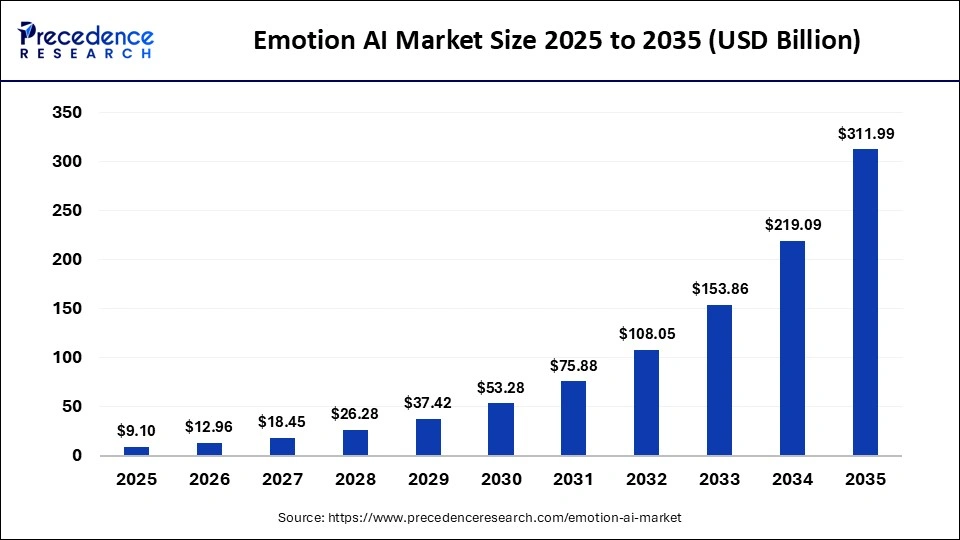
This remarkable growth reflects the rising importance of emotional intelligence in digital systems. From healthcare diagnostics to automotive safety and personalized marketing, Emotion AI—also known as affective AI—is redefining how machines interpret and respond to human emotions. As enterprises increasingly prioritize customer experience, behavioral insights, and real-time engagement, the demand for emotion-aware technologies is accelerating globally.
Read Also: Ready to Drink Beverages Market
How Does the Component Segment Shape the Emotion AI Market?
The component segment of the Emotion AI market is primarily led by the software segment, which accounted for approximately 72% of the total market share in 2025. This dominance is attributed to the extensive capabilities of software platforms that enable real-time emotion detection, sentiment analysis, and behavioral insights. Advanced tools such as facial recognition software, speech analytics platforms, and gesture recognition systems are empowering enterprises to better understand customer emotions and improve engagement strategies. These solutions are widely adopted across industries due to their scalability, flexibility, and integration capabilities with existing IT ecosystems.
Meanwhile, the hardware segment, holding around 16% share in 2025, plays a crucial role in enabling accurate data collection through devices such as cameras, microphones, and biometric sensors. The demand for high-quality sensors and wearable devices is increasing as organizations seek deeper physiological insights into emotional responses. Additionally, the services segment, which contributed nearly 12% in 2025, is expected to grow at the fastest pace due to rising demand for consulting, integration, and maintenance services. Businesses are increasingly relying on expert support to deploy customized Emotion AI solutions effectively.
Why is Machine Learning & Deep Learning Dominating the Technology Segment?
The machine learning & deep learning segment emerged as the leading technology in 2025, capturing around 55% of the market share. These technologies are fundamental to Emotion AI as they enable systems to analyze complex emotional patterns, process vast datasets, and continuously improve accuracy over time. Their ability to interpret subtle behavioral and physiological cues makes them indispensable in advanced emotion recognition systems.
The natural language processing (NLP) segment, with a 22% share, is gaining strong traction and is projected to grow at the fastest rate. NLP allows systems to analyze textual data from social media, customer feedback, and conversations to detect sentiment and emotional tone. In addition, computer vision, accounting for around 12%, plays a key role in analyzing facial expressions and body language through image and video data. The speech & voice recognition segment, with approximately 11% share, enhances emotion detection by interpreting vocal cues such as tone, pitch, and speech patterns, enabling more human-like interactions between machines and users.
How Are Applications Driving Demand Across Industries?
The healthcare & life sciences segment dominated the application landscape with a 30% market share in 2025. This is driven by the growing need for mental health monitoring, patient emotion tracking, and personalized treatment approaches. Emotion AI enables healthcare providers to detect emotional distress and deliver more effective interventions, thereby improving patient outcomes.
The automotive segment, holding around 22% share, is witnessing increasing adoption of Emotion AI for driver monitoring systems. These systems help detect fatigue, distraction, and stress levels, thereby enhancing road safety. Meanwhile, the retail & marketing segment (21%) is leveraging Emotion AI to analyze consumer sentiment in real time, enabling personalized marketing campaigns and improved customer experiences.
The education segment, with a 13% share, is benefiting from adaptive learning systems that adjust content based on students’ emotional states, making learning more engaging and effective. Additionally, the consumer electronics segment, accounting for around 14%, is expanding rapidly with the integration of Emotion AI into virtual assistants and smart home devices, enhancing user interaction and personalization.
What Role Do End Users Play in Market Expansion?
The enterprise & SMEs segment dominated the Emotion AI market in 2025, accounting for nearly 58% of the total share. Organizations across industries are increasingly adopting Emotion AI to enhance customer experience, improve workforce productivity, and gain actionable insights from emotional data. Integration with CRM, ERP, and analytics platforms further amplifies the value of Emotion AI for enterprises.
The academia & research institutes segment, with approximately 30% share, is playing a vital role in advancing Emotion AI technologies through research and innovation. These institutions are leveraging AI tools for behavioral studies, psychological research, and data analysis. Meanwhile, the government segment, holding around 12% share, is adopting Emotion AI for public safety, smart city initiatives, and improving citizen services. Governments are increasingly exploring emotional analytics to enhance situational awareness and service delivery efficiency
How is the Software Segment Evolving Beyond Traditional Analytics?
The software segment is not only dominating the Emotion AI market in terms of share but is also evolving rapidly in terms of capabilities and applications. Modern emotion AI software is increasingly being integrated with cloud computing platforms, enabling scalable deployment across global enterprises. These platforms now offer real-time emotional intelligence dashboards, predictive sentiment modeling, and API-based integrations that allow businesses to embed emotion recognition into customer service platforms, mobile apps, and digital interfaces.
Another major shift is the transition from reactive to predictive emotional analytics, where software solutions can anticipate customer reactions before they occur. This is particularly valuable in sectors like banking, healthcare, and e-commerce, where understanding emotional intent can directly impact decision-making and revenue generation. Additionally, the rise of SaaS-based emotion AI platforms is lowering entry barriers, allowing SMEs to adopt these technologies without heavy upfront investments.
What is Driving Innovation in Emotion AI Hardware?
The hardware segment is undergoing significant transformation with the emergence of advanced biometric sensing technologies. Modern devices are no longer limited to basic cameras and microphones; instead, they incorporate multi-modal sensors capable of detecting heart rate variability, skin conductance, and even micro-expressions. These innovations are enhancing the depth and accuracy of emotional analysis.
Wearable technology is another key driver, with smartwatches, AR/VR headsets, and health monitoring devices integrating emotion-sensing capabilities. In automotive applications, in-cabin sensors are becoming more sophisticated, enabling continuous monitoring of driver emotions in real time. Furthermore, edge computing is being increasingly deployed in hardware devices, allowing faster data processing without relying heavily on cloud infrastructure, which improves response time and data privacy.
Why Are Services Becoming a Critical Growth Engine?
The services segment is emerging as the fastest-growing component due to the increasing complexity of Emotion AI implementations. Enterprises require specialized expertise for customization, integration, and optimization of emotion AI systems within their existing digital ecosystems. Consulting services are helping organizations identify the most relevant use cases, while integration services ensure seamless deployment across platforms such as CRM, ERP, and customer engagement tools.
Moreover, continuous support and maintenance services are becoming essential as Emotion AI systems require regular updates, algorithm tuning, and compliance with evolving data privacy regulations. Managed services are also gaining traction, where third-party providers handle the end-to-end management of Emotion AI infrastructure, allowing businesses to focus on core operations.
How is NLP Redefining Emotional Intelligence in AI Systems?
Natural Language Processing (NLP) is rapidly redefining how machines interpret human emotions through text and speech. Beyond basic sentiment analysis, advanced NLP models are now capable of detecting sarcasm, context, intent, and emotional nuance in conversations. This is particularly impactful in customer service environments, where chatbots and virtual assistants can respond with greater empathy and relevance.
NLP is also playing a crucial role in analyzing unstructured data from social media, reviews, and online communities. Businesses are leveraging these insights to monitor brand perception, identify emerging trends, and respond proactively to customer concerns. The integration of NLP with multilingual capabilities is further expanding its adoption across global markets, enabling emotion AI systems to understand diverse linguistic and cultural contexts.
How is Computer Vision Enhancing Real-Time Emotion Detection?
Computer vision technology is becoming increasingly sophisticated, enabling highly accurate analysis of facial expressions, eye movements, and body language. Modern systems can detect subtle micro-expressions that are often imperceptible to the human eye, providing deeper insights into emotional states.
This technology is widely used in sectors such as retail, security, and healthcare. For instance, in retail environments, computer vision can analyze customer reactions to products or advertisements in real time, helping brands optimize store layouts and marketing strategies. In healthcare, it assists in monitoring patient emotions, particularly in mental health assessments. The integration of 3D imaging and depth-sensing cameras is further enhancing the precision of emotion detection systems.
What Makes Speech & Voice Recognition a Key Differentiator?
Speech and voice recognition technologies are adding a new dimension to Emotion AI by analyzing vocal characteristics such as tone, pitch, rhythm, and pauses. These elements provide valuable insights into a person’s emotional state, enabling more natural and empathetic interactions between humans and machines.
This technology is particularly impactful in call centers, where it helps identify customer frustration or satisfaction in real time, allowing agents to adjust their responses accordingly. It is also being widely adopted in virtual assistants and smart devices, improving user experience by making interactions more intuitive and human-like. As voice-based interfaces continue to grow, this segment is expected to play an increasingly important role in shaping the future of Emotion AI.
How is Emotion AI Transforming Healthcare Applications?
In healthcare, Emotion AI is revolutionizing patient care by enabling continuous emotional monitoring and early detection of mental health conditions. AI-driven systems can analyze facial expressions, speech patterns, and behavioral data to identify signs of stress, anxiety, or depression. This allows healthcare providers to intervene early and offer personalized treatment plans.
Additionally, Emotion AI is being integrated into telemedicine platforms, enhancing remote patient interactions by providing doctors with real-time emotional insights. This is particularly valuable in mental health consultations, where understanding a patient’s emotional state is critical. The technology is also being used in elderly care and rehabilitation programs, improving patient engagement and outcomes.
Why is Retail & Marketing a High-Growth Application Area?
Retail and marketing sectors are leveraging Emotion AI to create highly personalized and engaging customer experiences. By analyzing emotional responses to advertisements, products, and brand interactions, companies can tailor their strategies to resonate more effectively with their target audience.
Emotion AI enables real-time feedback on marketing campaigns, allowing businesses to optimize content and messaging dynamically. It also supports advanced customer segmentation based on emotional behavior, leading to more targeted and effective marketing efforts. As competition intensifies in the retail sector, the ability to understand and influence consumer emotions is becoming a key differentiator.
How Are Enterprises Accelerating Adoption of Emotion AI?
Enterprises are at the forefront of Emotion AI adoption, driven by the need to enhance customer experience, improve employee engagement, and gain deeper insights into consumer behavior. Large organizations are integrating Emotion AI into their digital transformation strategies, leveraging it across multiple functions such as marketing, HR, and customer service.
The availability of cloud-based solutions and subscription models is making it easier for SMEs to adopt Emotion AI technologies. These solutions offer scalability and flexibility, allowing businesses to start small and expand as needed. As competition increases across industries, organizations are recognizing the strategic value of emotional intelligence in gaining a competitive edge.
What is the Role of Academia & Government in Advancing Emotion AI?
Academic institutions and research organizations are playing a crucial role in advancing Emotion AI technologies through innovation and experimentation. They are exploring new algorithms, improving accuracy, and addressing ethical challenges associated with emotional data analysis. Their contributions are helping shape the future direction of the market.
Governments, on the other hand, are adopting Emotion AI for public sector applications such as security, law enforcement, and citizen services. Smart city initiatives are increasingly incorporating emotional analytics to enhance urban living experiences. However, governments are also focusing on establishing regulatory frameworks to address privacy and ethical concerns, ensuring responsible use of Emotion AI technologies.
Get Sample Link: https://www.precedenceresearch.com/sample/8282
For inquiries regarding discounts, bulk purchases, or customization requests, please contact us at sales@precedenceresearch.com
