
 by
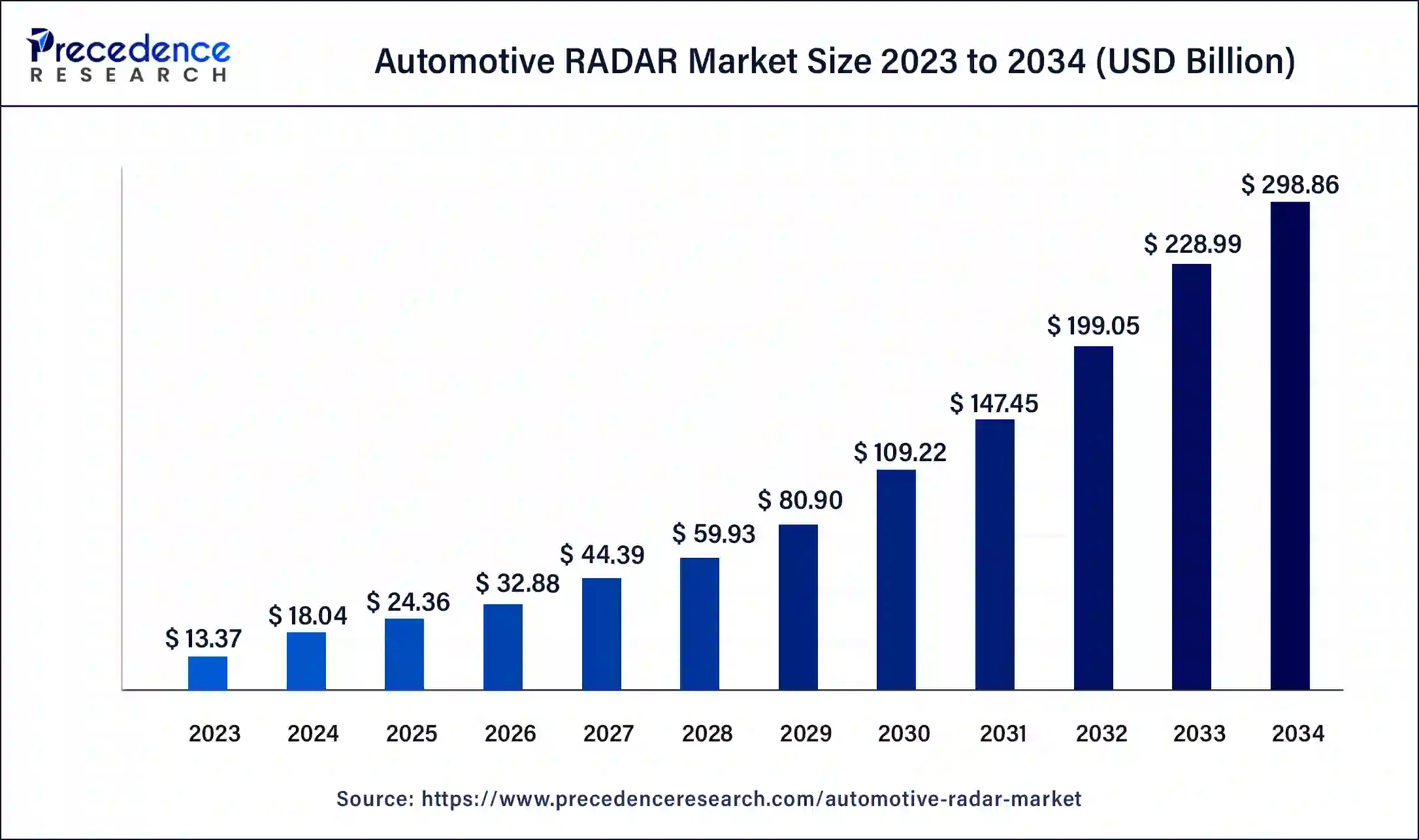
by The global automotive RADAR market size was valued at USD 7.68 billion in 2024 and is projected to increase from USD 8.66 billion in 2025 to approximately USD 25.6 billion by 2034, growing at a CAGR of 12.80% from 2025 to 2034. The growth of the market is primarily driven by the rising demand for advanced driver-assistance systems (ADAS), stricter government safety regulations, and technological advancements in imaging and AI-enabled radar systems.
Read Also: Augmented and Virtual Reality in Healthcare Market
Automotive RADAR Market Key Takeaways
-
Market value in 2025: USD 8.66 billion
-
Market value by 2034: USD 25.6 billion
-
Growth rate (CAGR): 12.80% from 2025 to 2034
-
Asia Pacific led the market with a 41% share in 2024
-
Europe is expected to grow at the fastest CAGR during the forecast period
-
By frequency: 77 GHz segment held the largest share of 58.2% in 2024
-
By frequency: 79 GHz segment to grow at a CAGR of 15.3%
-
By application: Adaptive Cruise Control (ACC) dominated with a 22.7% share in 2024
-
By vehicle type: Passenger car segment held 71.5% market share in 2024
-
By range: Long-range radar (LRR) led with 43.6% market share in 2024
Market Overview
The automotive RADAR market is witnessing substantial growth driven by increasing demand for vehicle safety, comfort, and automation. Radar systems play a crucial role in ADAS and autonomous driving by enabling accurate object detection, distance measurement, and collision avoidance. Government regulations and initiatives for road safety and emission control are pushing automakers to integrate radar-based technologies into vehicles. The integration of AI and machine learning into radar systems enhances target detection, object classification, and driving safety under various environmental conditions.
Regional Insights
Asia Pacific
The Asia Pacific automotive RADAR market was valued at USD 3.15 billion in 2024 and is projected to reach USD 10.62 billion by 2034, expanding at a CAGR of 12.95%.
The region dominates the global market due to rising vehicle production, growing consumer purchasing power, and adoption of smart mobility solutions. Countries like China, India, South Korea, and Japan are at the forefront of implementing radar-enabled technologies to improve road safety and promote sustainable transportation.
The ongoing green revolution in mobility and the rapid shift toward electric vehicles have further accelerated RADAR system adoption across the region.
Europe
Europe is expected to witness significant growth over the forecast period, driven by government incentives for electric and autonomous vehicles. European countries such as Germany and the UK are emphasizing safety and environmental protection through regulations that encourage the use of radar-based technologies.
According to the European Automobile Manufacturers’ Association (ACEA), over 2.2 million electrified vehicles were registered across Europe between January and April 2025, marking a 20% increase compared to the previous year. The growing EV market presents a strong opportunity for radar adoption in next-generation vehicles.
Market Growth Factors
-
Rising Demand for Vehicle Safety Features
Increasing cases of road accidents have led to the widespread adoption of collision avoidance systems, adaptive cruise control, and lane departure warnings, all powered by radar. -
Stringent Government Regulations
Agencies like the NHTSA and the European Union have imposed strict safety standards mandating advanced driver-assistance features, including short and long-range radars operating in the 77–81 GHz frequency range. -
Technological Advancements in ADAS
The introduction of next-generation Advanced Driver Assistance Systems (ADAS) and autonomous driving technologies has been a major market catalyst. AI-driven radar systems enhance real-time decision-making in complex driving environments. -
Growth of Electric and Autonomous Vehicles
Increasing production of EVs and autonomous vehicles globally requires radar integration for 360-degree environmental awareness and object detection. -
Improved Comfort and Driving Experience
The incorporation of radar-enabled features such as adaptive cruise control and automatic braking ensures a smoother and safer driving experience, contributing to consumer demand.
Frequency Insights
The 77 GHz segment led the market in 2024 with a 58.2% share, driven by its superior range and resolution essential for ADAS and autonomous driving systems. It supports long-range object detection (up to 250 meters) and improved accuracy.
The 79 GHz segment is expected to grow at the fastest CAGR of 15.3%, supported by regulatory approval and enhanced range resolution. Innovations such as digital beamforming and radar-on-chip technologies are boosting adoption in passenger and commercial vehicles.
Range Insights
The long-range radar (LRR) segment dominated with a 43.6% share in 2024, primarily due to its application in adaptive cruise control and automatic emergency braking.
Meanwhile, the short-range radar (SRR) segment is expected to grow rapidly, driven by increasing demand for blind-spot detection, parking assistance, and traffic jam assist systems.
Technology Insights
The frequency-modulated continuous wave (FMCW) radar segment held the largest share of 48.9% in 2024 due to its ability to provide precise distance and velocity measurements while consuming minimal power.
The AI-enabled and machine learning radar segment is expected to grow at a remarkable CAGR of 18.2%, as automakers integrate smart radar systems capable of operating effectively under challenging weather conditions such as rain, fog, and snow.
Component Insights
The radar transceiver (Tx/Rx) segment accounted for the largest share of 31.4% in 2024, driven by its fundamental role in enabling ADAS functionalities like blind spot detection and automatic braking.
Meanwhile, the software and signal processing algorithms segment is witnessing strong growth, as radar systems increasingly rely on AI-based signal interpretation, anomaly detection, and adaptive beamforming to enhance real-time perception accuracy.
Application Insights
The adaptive cruise control (ACC) segment dominated the market with a 22.7% share in 2024, supported by its widespread implementation in modern passenger cars and SUVs.
The imaging/4D radar segment is the fastest-growing, projected to expand at a CAGR of 17.9% during the forecast period. Its ability to provide a detailed 3D environmental map makes it vital for next-generation autonomous driving.
Vehicle Type Insights
The passenger car segment accounted for 71.5% of the market in 2024, driven by the rising adoption of ADAS technologies and government-mandated safety standards.
The heavy commercial vehicle (HCV) segment is growing at a CAGR of 13.1%, supported by increasing integration of radar-based safety systems in long-haul and logistics vehicles to reduce accidents and improve operational efficiency.
For inquiries regarding discounts, bulk purchases, or customization requests, please contact us at sales@precedenceresearch.com
