
 by
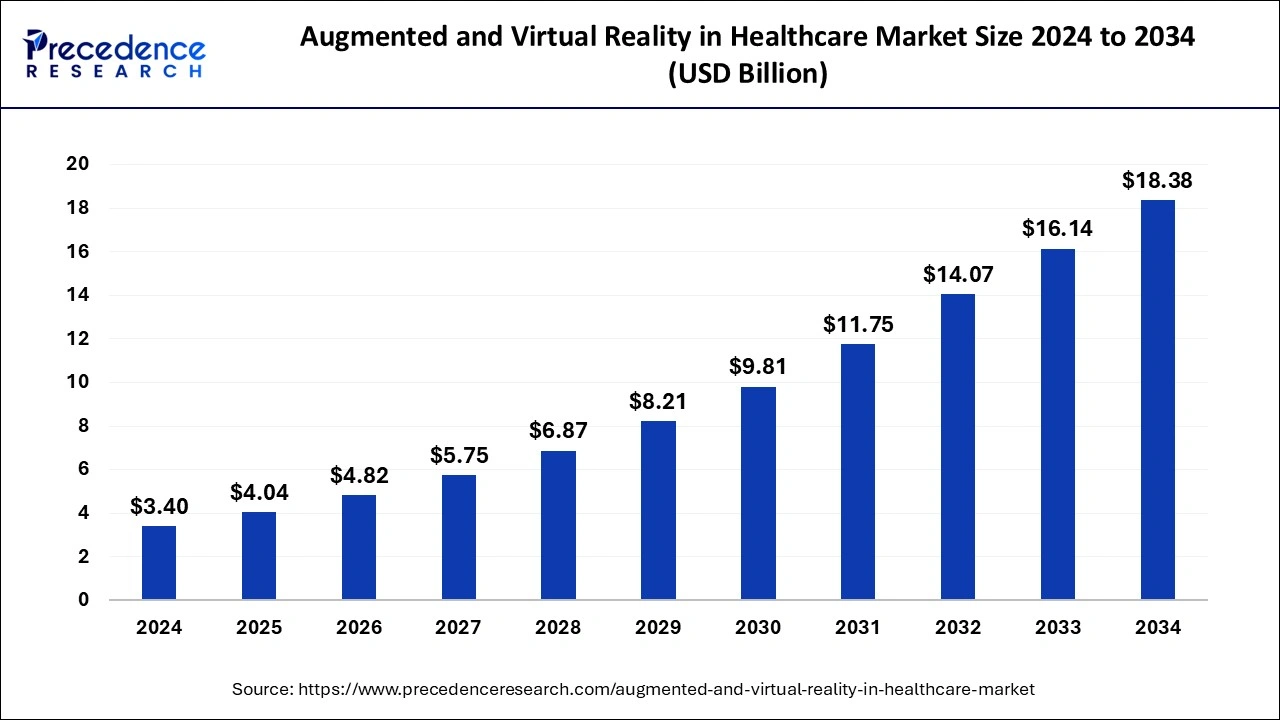
by The global augmented and virtual reality in healthcare market size was estimated at USD 3.40 billion in 2024 and is projected to reach around USD 18.38 billion by 2034, growing at a CAGR of 18.38% from 2025 to 2034. The growing digitalization of healthcare systems, increasing use of immersive technology for training, diagnosis, and treatment, and the rising focus on precision-driven procedures are major factors driving this market’s growth.
Read Also: Flexible Packaging Market
Augmented and Virtual Reality in Healthcare Market Key Takeaways
-
Market Size 2024: USD 3.40 Billion
-
Market Size 2034: USD 18.38 Billion
-
CAGR (2025–2034): 18.38%
-
Dominant Region (2024): North America (41% share)
-
Leading Technology: Augmented Reality (61% share in 2024)
-
Leading Component: Hardware (67.8% share in 2024)
U.S. Augmented and Virtual Reality in Healthcare Market Size and Forecast 2025 to 2034
The U.S. augmented and virtual reality in healthcare market reached USD 980 million in 2024 and is anticipated to be worth approximately USD 5.49 billion by 2034, expanding at a CAGR of 18.81%.
North America leads the market due to strong R&D initiatives, high government support, and substantial investments from healthcare and tech companies.
Additionally, the U.S. healthcare sector is increasingly adopting AR/VR for surgical visualization, training, remote monitoring, and therapy applications—driving continuous innovation across hospitals and research institutes.
The Asia Pacific region is also witnessing rapid adoption, supported by rising awareness of AR/VR’s benefits, growing healthcare investments, and technology integration in medical training and patient care.
Market Overview
The integration of augmented reality (AR) and virtual reality (VR) in healthcare has revolutionized the way medical professionals learn, diagnose, and treat patients. These technologies enable real-time visualization, immersive simulations, and enhanced patient engagement.
For example, Google Glass provides AR overlays that assist in surgical visualization, while VR headsets offer immersive training experiences and help patients manage pain or anxiety.
AR and VR technologies are being increasingly utilized to:
-
Train medical students and surgeons through realistic simulations
-
Visualize anatomy and veins during procedures
-
Improve patient comfort and rehabilitation outcomes
-
Facilitate precise and minimally invasive surgeries
Overall, AR/VR is redefining medical education, patient care, and operational efficiency across the global healthcare system.
Market Growth Factors
1. Increased Digitalization of the Healthcare Sector
Digital transformation across hospitals and clinics has accelerated the adoption of AR and VR tools. From electronic health records to immersive diagnostic imaging, digitalization enhances workflow efficiency and clinical accuracy.
2. Growing Focus on Medical Training and Education
Medical schools and hospitals are leveraging AR/VR for interactive anatomy learning, surgical simulations, and skill enhancement. These platforms allow professionals to practice high-risk procedures in a controlled, virtual setting—reducing errors and improving patient safety.
3. Rising Precision and Accuracy in Procedures
VR and AR technologies provide real-time visualization of organs and blood flow during surgeries, enabling greater precision and minimizing invasiveness. Enhanced visibility improves surgical planning, execution, and post-operative outcomes.
4. Improved Diagnosis and Patient Experience
VR enables immersive diagnostic environments, while AR overlays assist radiologists and surgeons in interpreting imaging data more accurately. Patients also benefit through virtual therapy, pain management, and mental health treatments.
5. Expanding Applications in Rehabilitation and Therapy
VR and AR platforms are increasingly used for physical and cognitive rehabilitation, helping patients recover faster with personalized and engaging exercises.
The technology’s ability to simulate real-world scenarios aids in therapy and behavioral health programs.
Market Dynamics
Drivers
-
Favorable reimbursement policies: Many nations are introducing AR/VR-related reimbursement schemes for specific procedures, accelerating adoption in surgeries and therapies.
-
Technological advancements: Ongoing R&D and government initiatives are fostering innovation and enabling better healthcare accessibility.
Challenges
-
Lack of skilled professionals: Technical expertise and infrastructure limitations remain key barriers. High-resolution systems and device costs can also restrict adoption in developing regions.
Opportunities
-
Enhanced surgical visualization: VR and AR provide 3D visuals of patient anatomy, aiding complex procedures.
-
Accuracy in diagnosis: Real-time imaging overlays and immersive diagnostic tools improve detection and treatment planning.
Component Insights
The hardware segment dominated the market in 2024 with a 67.8% share.
This includes AR devices such as smart glasses, head-mounted displays (HMDs), and handheld devices, and VR devices such as gesture-tracking tools, haptic feedback systems, and VR headsets.
Hardware advancements are improving diagnostic imaging, patient monitoring, and telepresence surgery.
The services segment is projected to grow at the fastest CAGR of 20.40%, supported by rising demand for installation, maintenance, and training programs. Integration services are essential to ensure compatibility of AR/VR hardware and software in complex hospital ecosystems.
Application Insights
The medical training and education segment held the largest share of 29.50% in 2024.
AR/VR simulation models enhance nursing education, anatomy learning, and surgical training—offering cost-effective, safe, and repeatable experiences for medical professionals.
The telemedicine and remote monitoring segment is expected to expand at a CAGR of 21.20%, fueled by post-pandemic digitization and the rise of virtual care models. VR-based telehealth systems support remote consultations, virtual hospital rounds, and therapy sessions.
Technology Insights
The virtual reality (VR) segment dominated the market with a 58.60% share in 2024.
VR applications—ranging from pain management to rehabilitation and simulation-based medical training—have proven effective in improving clinical outcomes. Fully immersive VR solutions are being used to enhance patient comfort, facilitate virtual exposure therapy, and accelerate recovery.
The augmented reality (AR) segment is expected to grow at a CAGR of 19.10% through 2034.
AR applications—such as marker-based surgical overlays, projection-based visualization, and superimposed 3D imaging—are empowering surgeons with real-time data for precision-based interventions.
End-user Insights
The hospitals and surgical centers segment accounted for 34.30% of the market share in 2024, as healthcare institutions adopt AR/VR tools to improve patient outcomes, optimize procedures, and train surgeons effectively.
The patients/home users segment is projected to grow at a CAGR of 20.80%, driven by applications in remote therapy, physical rehabilitation, and mental health support.
The growing use of VR for stress reduction, phobia management, and guided therapy sessions is expanding adoption among individual consumers.
Regional Insights
North America
North America dominated the global market with a 41% share in 2024, driven by robust healthcare infrastructure, innovation hubs, and regulatory support.
The U.S. market, valued at USD 980 million in 2024, is forecasted to reach USD 5.49 billion by 2034, reflecting strong investment in AR/VR research, medical training, and digital transformation.
Asia Pacific
Asia Pacific is projected to witness significant growth due to rising awareness, healthcare digitization, and rapid adoption of AR/VR technologies in India, China, Japan, and South Korea.
Government programs encouraging technology-based education and healthcare reforms are also contributing to regional market expansion.
Key Market Players
-
Eon Reality, Inc.
-
Layar
-
Bioflight VR
-
WorldViz
-
TheraSim Inc.
-
CAE Inc.
-
GE Healthcare
-
Koninklijke Philips N.V.
-
Intuitive Surgical
-
Siemens Ltd.
-
Mindmaze
For inquiries regarding discounts, bulk purchases, or customization requests, please contact us at sales@precedenceresearch.com
