
 by
by Introduction
The appointment scheduling software market is experiencing rapid growth as businesses and service providers across healthcare, education, retail, hospitality, and other sectors transition from manual scheduling processes to automated, digital solutions. These platforms streamline appointment bookings, reduce administrative overhead, and enhance customer satisfaction by enabling 24/7 self‑service scheduling.
With technological advancements like AI automation, mobile integration, and cloud‑based platforms, appointment scheduling software is no longer a luxury but a core operational tool for modern enterprises.
Read Also: Direct Attached AI Storage System Market
Market Size & Forecast
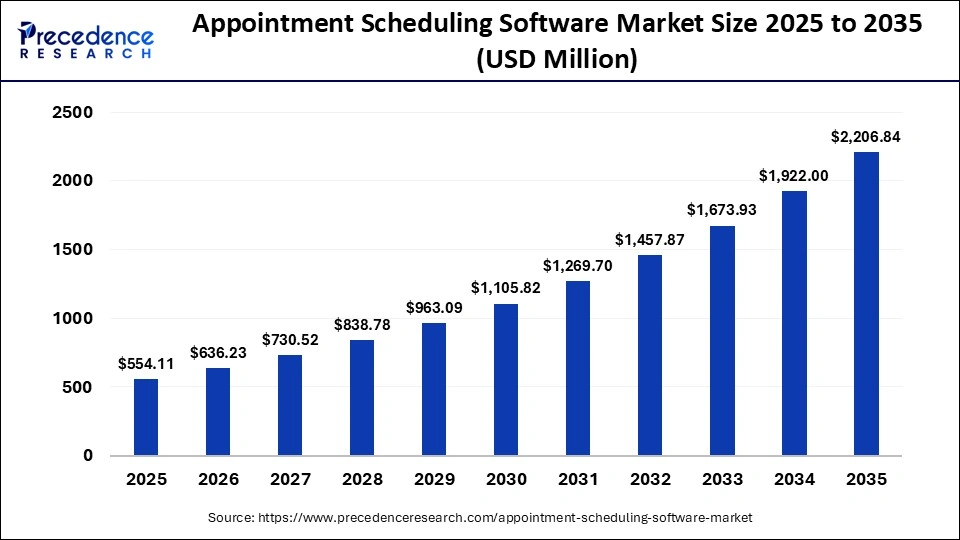
The global appointment scheduling software market size was valued at USD 1,735.2 million in 2025 and is expected to grow from USD 1,907.9 million in 2026 to approximately USD 6,235.6 million by 2035, registering a strong CAGR of 13.7% between 2026 and 2035.
This remarkable expansion reflects businesses’ increasing need for scheduling efficiency, digital transformation, and enhanced customer experience.
Market Overview
Appointment scheduling software enables organizations to:
- Automate intake and booking workflows
- Provide real‑time availability status
- Send reminders and notifications
- Integrate with calendars and CRM systems
- Support multi‑channel booking (web, mobile, social media)
These systems help reduce manual errors, no‑shows, and wait times, ultimately improving operational productivity and client engagement.
Key Market Drivers
1. Increasing Adoption of Digital Solutions
Digitization initiatives across sectors are propelling demand for automated scheduling tools that eliminate paperwork and reduce administrative burden.
2. Growth of the Healthcare Sector
The healthcare industry remains a pivotal adopter, as appointment scheduling software enhances patient flow management, reduces no‑show rates, and integrates with telehealth services.
3. Rising Preference for Self‑Service Booking
Customers increasingly prefer platforms that allow 24/7 booking, cancellations, and rescheduling without human intervention—a trend accelerated by mobile app usage.
4. Cloud‑Based Deployment
Cloud‑based scheduling solutions offer:
- Scalability
- Lower IT costs
- Remote access
- Automatic updates
These advantages are driving cloud adoption, especially among SMEs.
5. AI & Automation Integration
Artificial intelligence is making scheduling more efficient through:
- Smart booking suggestions
- Conflict resolution
- Predictive analytics
- Automated reminders
Market Trends
Mobile Scheduling and Apps
Mobile‑friendly platforms allow users to book appointments on the go, driving usage among millennials and Gen Z customers.
Integration with Telehealth
Particularly in healthcare, scheduling software integrates seamlessly with telehealth platforms, supporting virtual consultations.
Personalization and Customer Experience
Algorithms now offer personalized booking options based on user history, preferences, and behavior.
Contactless Scheduling
COVID‑19 accelerated contactless bookings, which continue to be preferred in service‑oriented sectors.
Segment Analysis
By Deployment Type
- Cloud‑Based – largest and fastest‑growing segment
- On‑Premise
Cloud‑based solutions dominate due to flexibility, cost efficiency, and remote accessibility.
By Organization Size
- Large Enterprises – significant share due to high demand for centralized scheduling across departments
- Small & Medium Enterprises (SMEs) – fastest‑growing segment as SaaS pricing models become more affordable
By End Use
- Healthcare – dominant segment
- Education
- Retail & eCommerce
- Salon & Spa
- Corporate Services
- Others
Healthcare continues to lead due to high appointment volumes and the need for patient lifecycle management. Other sectors like salons, education institutions, and corporate services are increasing adoption owing to customer convenience and operational efficiency.
Regional Insights
North America
North America held the largest market share in 2025, supported by:
- Early technology adoption
- Presence of major software vendors
- High digital literacy
- Strong healthcare IT investments
Europe
Europe follows with stable growth, driven by digital transformation across healthcare and service sectors, and strong presence of tech startups offering innovative scheduling solutions.
Asia‑Pacific
Asia‑Pacific is projected to register the fastest CAGR over the forecast period due to:
- Rapid digitization across industries
- Expansion of healthcare facilities
- Growing adoption of cloud‑based applications
Countries such as India, China, and Southeast Asian economies present huge growth potential.
Competitive Landscape
The appointment scheduling software market is competitive and fragmented, with players focusing on feature differentiation, partnerships, integrations, and pricing models. Key companies include:
- Microsoft Corporation
- Google LLC
- Zoho Corporation
- Calendly LLC
- Square Inc.
- Amelia Scheduling Software
- Acuity Scheduling
- Booker Software
- Appointy Software
- Setmore
These vendors are investing in AI capabilities, mobile app enhancements, and integrations with CRM, EMR, and payment systems to strengthen their offerings.
Recent Developments
- Advanced AI Scheduling: Some platforms now leverage machine learning to predict optimal appointment slots.
- Integration with Virtual Assistants: Voice‑enabled booking through AI assistants improves user convenience.
- Enhanced Security Features: As scheduling systems store sensitive data, advanced encryption and access control are now standard.
Market Opportunities
- Telehealth and remote service integration
- AI‑driven optimization for large enterprises
- Mobile‑first scheduling platforms
- Advanced analytics for reducing no‑shows and cancellations
Challenges
Despite strong growth, the market faces challenges:
- Data Privacy Concerns: Handling personal information requires strict compliance with regulations like GDPR.
- Integration Complexity: Challenges in integrating scheduling software with legacy systems.
- User Adoption Barriers: Resistance from traditional businesses that rely on manual processes.
Conclusion
The appointment scheduling software market is poised for strong expansion through 2035 as businesses increasingly adopt digital systems to enhance operational efficiency and customer experience. Cloud‑based solutions, AI integration, and mobile‑first platforms will continue to transform how appointments are booked and managed across industries.
With rising demand in healthcare, service sectors, and SMB environments, scheduling software is set to remain a critical tool for organizational productivity and customer engagement.
Get Sample Link: https://www.precedenceresearch.com/sample/8272
For inquiries regarding discounts, bulk purchases, or customization requests, please contact us at sales@precedenceresearch.com
