
 by
by Market Accelerates Amid Rising Air Travel and Technological Advancements
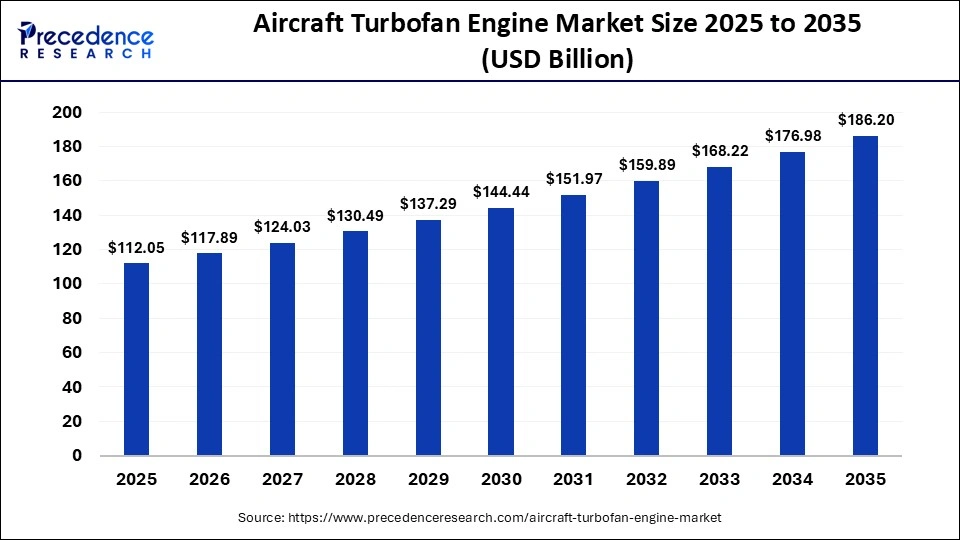
The global aircraft turbofan engine market is entering a new phase of sustained growth, driven by increasing air travel demand, fleet modernization, and rapid advancements in aerospace engineering. According to Precedence Research, the market was valued at USD 112.05 billion in 2025 and is projected to grow from USD 117.89 billion in 2026 to approximately USD 186.20 billion by 2035, expanding at a CAGR of 5.21%.
As airlines and defense sectors prioritize efficiency, sustainability, and performance, turbofan engines remain the backbone of modern aviation propulsion systems.
Read Also: AI Email Assistant Market
Understanding Turbofan Engine Technology
Aircraft turbofan engines are among the most widely used propulsion systems in commercial and military aviation. These engines feature a large front fan that directs airflow around the engine core, producing thrust more efficiently than traditional jet engines.
This design delivers a powerful combination of:
- Enhanced fuel efficiency
- Lower noise levels
- Reduced emissions
- Improved thrust performance at subsonic speeds
The ability to balance performance and environmental compliance makes turbofan engines indispensable in today’s aviation ecosystem.
Key Market Insights at a Glance
- Market Size (2026): USD 117.89 Billion
- Forecast (2035): USD 186.20 Billion
- Growth Rate: CAGR of 5.21%
- Leading Region: North America (37% share in 2025)
- Fastest Growth: Asia Pacific
Segment Highlights:
- Engine Type: High bypass turbofan leads with ~60% share
- Application: Commercial aviation dominates with ~68% share
- Component: Fan & compressor segment holds ~30% share
- Thrust Range: Above 50,000 lbf dominates with ~50% share
AI Integration: Redefining Engine Performance
Artificial Intelligence (AI) is reshaping the aircraft turbofan engine market by introducing smarter, more efficient operational capabilities.
AI-driven innovations include:
- Predictive maintenance systems that reduce unexpected failures
- Generative design tools for lightweight and high-performance components
- Real-time monitoring via IoT sensors for improved engine health tracking
- Optimized fuel consumption and flight paths
These advancements not only reduce operational costs but also enhance safety and sustainability across aviation operations.
Emerging Trends Driving Market Growth
The aircraft turbofan engine market is evolving rapidly, supported by several transformative trends:
- Growing adoption of lightweight composite materials for durability and efficiency
- Increasing use of additive manufacturing (3D printing) in engine production
- Expansion of Maintenance, Repair, and Overhaul (MRO) services
- Rising investments in defense modernization programs
- Accelerating demand for fuel-efficient and low-emission engines
Market Dynamics
Driver: Surge in Aircraft Production
Global aircraft production is witnessing a strong rebound. Manufacturers such as Boeing and Airbus are increasing output to meet rising passenger demand and airline fleet expansion.
In 2025, more than 1,400 aircraft were delivered globally, reflecting a sharp increase in production and signaling strong future demand for turbofan engines.
Restraint: High Development Costs
Despite strong growth prospects, the market faces challenges due to:
- High capital investment required for advanced engine development
- Supply chain disruptions and material shortages
- Complex regulatory and certification processes
Opportunity: Sustainable Aviation
The increasing focus on sustainability is creating new opportunities for turbofan engine manufacturers. Airlines are actively adopting engines that:
- Reduce fuel consumption
- Lower carbon emissions
- Comply with global environmental regulations
This shift is expected to drive the adoption of next-generation engine technologies across the aviation sector.
Segment Analysis
Engine Type
- High Bypass Turbofan: Dominates due to fuel efficiency and low noise
- Low Bypass Turbofan: Preferred in high-speed military aircraft
- Geared Turbofan (GTF): Fastest-growing segment due to improved efficiency and reduced emissions
Application
- Commercial Aviation: Largest segment with 68% share
- Military Aviation: Growing due to defense modernization
- Business & General Aviation: Rising demand for private jets
Thrust Range
- Above 50,000 lbf: Dominates long-haul aircraft
- 20,000–50,000 lbf: Fastest-growing for narrow-body jets
- Below 20,000 lbf: Used in regional and business aviation
Component
- Fan & Compressor: Core to airflow and efficiency
- Turbine: Essential for power generation
- Combustor: Focused on emission reduction
- Gearbox: Key innovation in geared turbofan engines
Regional Landscape
North America dominates the market due to strong R&D investments and the presence of leading players like GE Aerospace and Pratt & Whitney.
Asia Pacific – Fastest Growing Region
The region is witnessing rapid growth driven by rising air travel, fleet expansion, and increasing investments in aviation infrastructure across China, India, and Japan.
Europe – Innovation Hub
Europe continues to play a crucial role with key players such as Rolls-Royce Holdings plc and Safran Aircraft Engines, supported by stringent environmental policies.
Competitive Landscape
Key companies shaping the aircraft turbofan engine market include:
- GE Aerospace
- Rolls-Royce Holdings plc
- Pratt & Whitney
- Safran Aircraft Engines
- Honeywell International Inc.
- MTU Aero Engines AG
Recent Developments
- In 2026, Honeywell Aerospace launched the HON6000 turbofan engine, designed for advanced combat and autonomous aircraft.
- GE Aerospace achieved a major milestone in hybrid-electric propulsion technology demonstration.
Conclusion
The aircraft turbofan engine market is poised for steady expansion as the aviation industry continues to evolve toward greater efficiency, sustainability, and digital transformation. With AI integration, advanced materials, and increasing global air travel, turbofan engines will remain central to the future of aerospace innovation.
Get Sample: https://www.precedenceresearch.com/sample/8267
For inquiries regarding discounts, bulk purchases, or customization requests, please contact us at sales@precedenceresearch.com
