
The global AI Data Centers market is set to skyrocket from USD 17.54 billion in 2025 to a remarkable USD 165.73 billion by 2034, achieving an impressive CAGR of 28.34%. This explosive growth is fueled by the relentless adoption of artificial intelligence to optimize data flow, the demand for high-performance computing, and bold investments in next-generation data center infrastructure.
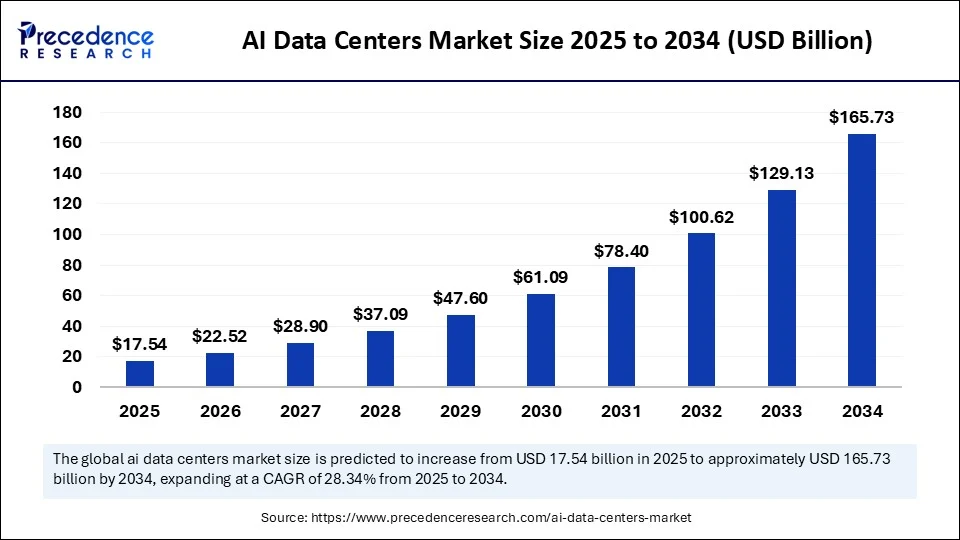
The United States market alone is forecast to reach USD 46.15 billion by 2034, reflecting both its advanced technological ecosystems and surging industry adoption rates.
Quick Insights
-
Market size (2024): USD 13.67 billion
-
Forecasted market size (2034): USD 165.73 billion
-
Forecasted CAGR (2025-2034): 28.34%
-
Leading region (2024): North America
-
Fastest-growing region: Asia Pacific
-
Largest segment (2024): Hardware (driven by GPUs, ASICs)
-
Top application: Training workloads
-
Dominant data center type: Hyperscale facilities
-
Leading innovator: United States (key players: Microsoft, IBM, NVIDIA)
-
Noteworthy breakthroughs: Underwater cooling in China, liquid cooling tech, and sustainable approaches across Europe and Asia
Get a Sample: https://www.precedenceresearch.com/sample/6494
Where Does the Big Opportunity Lie in the AI Data Centers Market?
How will regulatory pushes, new hardware, and sustainability efforts shape the next decade?
Industry transformation is moving at breakneck speed:
-
Sustainability: Demand for “green” AI data centers that minimize energy and water usage, reduce emissions, and harness renewable power.
-
AI-specific hardware: Investment in GPUs, TPUs, and ASICs is enabling powerful, efficient data processing at scale.
-
Edge computing: Real-time analytics for smart cities and autonomous vehicles is fueling demand for decentralized data centers.
-
Government Initiatives: From Asia’s smart city projects and digitalization funding to Europe’s strong focus on renewable energy data centers and privacy regulations, support is robust and global.
-
Healthcare & Life Sciences: Expected to be the fastest-growing end-user sector due to the rise in personalized medicine, genomics, and AI-assisted diagnostics.
Market Scope
| Report Coverage | Details |
| Market Size by 2034 | USD 165.73 Billion |
| Market Size in 2025 | USD 17.54 Billion |
| Market Size in 2024 | USD 13.67 Billion |
| Market Growth Rate from 2025 to 2034 | CAGR of 28.34% |
| Dominating Region | Asia Pacific |
| Fastest Growing Region | North America |
| Base Year | 2024 |
| Forecast Period | 2025 to 2034 |
| Segments Covered | Component, Data Center Type, AI Workload Type, Cooling Infrastructure, Power Capacity, Deployment Mode, End-User Industry, and Region |
| Regions Covered | North America, Europe, Asia-Pacific, Latin America, and Middle East & Africa |
Regional & Segmentation Highlights
-
North America: Remained the revenue leader in 2024, thanks to mature tech infrastructure and rapid corporate AI adoption. Key U.S. firms are investing heavily in AI-ready data centers and innovative solutions such as advanced cooling and intelligent automation.
-
Asia Pacific: Poised for the fastest growth with major contributions from China, India, Singapore, and Japan. Government-led policies, massive smart city deployments, digital infrastructure advancements, and the adoption of novel cooling systems like underwater cooling have been game changers.
-
Europe: Focuses on sustainable and energy-efficient data center designs. Hyperscalers continue to dominate, especially in the UK, Germany, and France, propelled by strong national AI strategies and high targets for renewables.
Latest Industry Breakthroughs
Leading players like Microsoft, IBM, and NVIDIA are driving the market’s innovative edge with AI-optimized hardware and advanced liquid cooling techniques. In China, investments in underwater cooling technology have set new benchmarks for efficiency, while European firms continue to pioneer sustainable design architectures.
Data Privacy, Cybersecurity, and Cost Pressures
Despite positive momentum, the sector faces hurdles:
-
Data privacy & compliance: Heightened risk of breaches makes robust cybersecurity non-negotiable and raises operating costs.
-
Regulatory complexity: GDPR, CCPA, and similar regulations demand major investments in security and transparency.
-
Rising costs: Next-generation AI hardware and advanced cooling come with a premium, pressing profit margins for new entrants.
Expert Perspective
“With the rapid acceleration of AI workloads, the demand for data center innovations—whether in cooling, compute, or sustainability—is at an all-time high. The winners in this race will be those who combine technical excellence with compliance, green initiatives, and strategic partnerships,” says Dr. Kavita Sharma, Principal Consultant at Precedence Research.
Read Also: Aerospace Artificial intelligence Market Size to Surpass USD 50.20 Billion by 2034
AI Data Centers Market Segments
By Offering
The aerospace AI market is structured around three main offerings: hardware, software, and services. Software maintains the largest market share as of 2024, making up more than a third of sector revenues, thanks to its critical role in enabling AI algorithms for predictive analytics, mission planning, and real-time operational decision-making. Hardware components like advanced GPUs, ASICs, FPGAs, memory, and sophisticated sensors form the backbone of data gathering and processing tasks in aircraft and satellites, while the fastest growth is seen in services, especially deployment, integration, training, and consulting, as organizations seek expert help to navigate increasingly complex AI system rollouts and maximize return on these transformative investments.
By Technology
Machine learning shines as the dominant technology in aerospace AI, accounting for over 41% of adoption. It powers everything from anomaly detection in predictive maintenance to autonomous navigation and optimized fuel management. The field comprises sub-disciplines such as supervised, unsupervised, reinforcement, and deep learning, each deployed for specific aviation and space use-cases. Other major technologies include natural language processing—revolutionizing cockpit and control center communication—computer vision, driving real-time image analysis for surveillance and navigation, and context awareness, which enables smarter, adaptive systems capable of making mission-critical decisions in dynamic environments.
By Application
AI is radically reshaping a spectrum of aerospace applications, with flight operations emerging as the most influential segment, boosting safety, efficiency, and cost savings through intelligent routing, real-time data analytics, and automated decision support for pilots. The reach of AI extends to predictive maintenance, streamlining repairs and minimizing downtime, robotics-assisted manufacturing and assembly operations, and advanced training simulators for flight crews and maintenance teams. In air traffic management, AI allows real-time route optimization and collision avoidance, while autonomous systems now govern smart drones, unmanned vehicles, and security applications such as satellite image analysis and border surveillance.
By Platform
Across platforms, commercial aircraft represent the largest market share, as airlines race to leverage AI for operational efficiency and enhanced passenger safety. Military aircraft platforms integrate AI for next-generation autonomy, threat detection, and battle management, while business and general aviation exploit AI tools for improved pilot assistance and cost efficiency. Unmanned Aerial Vehicles (UAVs) and satellites, particularly in defense and remote sensing, show the fastest adoption rates as AI enables greater autonomy, mission flexibility, and real-time decision making even in the harshest conditions, including deep space and at the edge of the atmosphere.
By Deployment
On-premises deployment holds the lion’s share at over 52% in 2024—a testament to the aerospace industry’s prioritization of security, control, and compliance with rigorous regulations, especially for mission-sensitive applications. However, as AI workloads and global operations scale up, cloud-based and edge deployments are rapidly gaining traction, valued for their agility, scalability, and ability to process data as close to the source as possible—key for mission-critical scenarios demanding instantaneous action and minimal latency.
By End User
Among end users, Original Equipment Manufacturers (OEMs) lead the market, thanks to their role in integrating advanced avionics, navigation, and pilot-assist systems into new aircraft and platforms. Airlines are swiftly expanding AI adoption to optimize flight operations and improve customer experiences, while defense organizations drive AI innovation in autonomy, surveillance, and mission systems. Airport authorities, MRO firms, and space agencies each leverage AI to enhance safety, cut costs, streamline traffic, automate maintenance, and manage highly complex logistical and technological challenges within sprawling regional and global operations.
Get Started: Download the Sample or Schedule a Meeting
Ready to harness the future of AI data centers?
Download a Sample Report
| Email: sales@precedenceresearch.com |
Or schedule your expert session with a Precedence Research analyst now.
About Precedence Research
Precedence Research delivers industry-leading market intelligence and expert analysis to empower forward-thinking strategies in the global economy. Our data-driven reports are trusted by Fortune 500s, venture-backed disruptors, and governments worldwide.
Contact:
Precedence Research
Email: sales@precedenceresearch.com
Pune, India | United States | Europe

