
 by
by Explore the booming Urban Air Mobility market expected to grow from USD 6.54 billion in 2025 to USD 92.6 billion by 2034 at a CAGR of 34.24%. Discover key drivers, trends, and regional insights.
Overview: The Sky Is No Longer the Limit
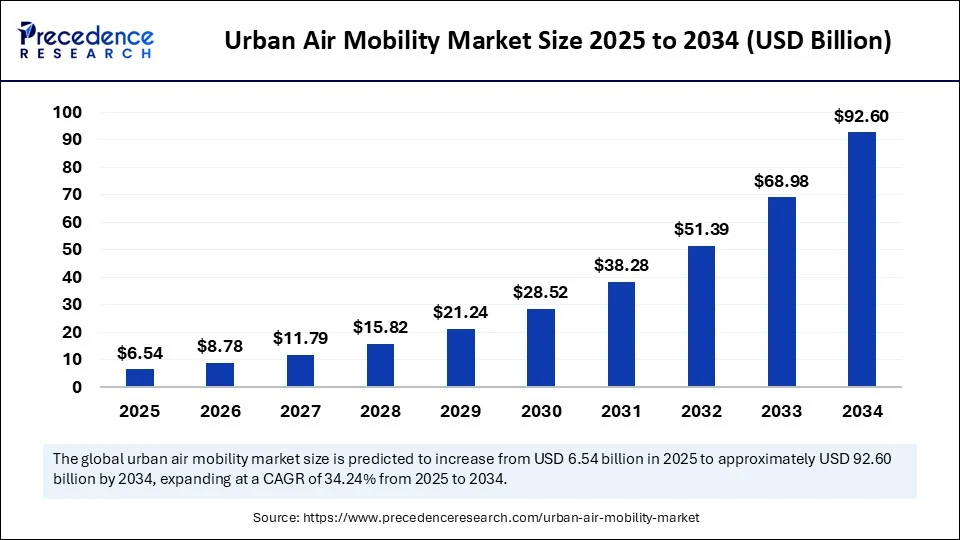
The global Urban Air Mobility (UAM) market is rapidly evolving from concept to reality, projected to grow from USD 6.54 billion in 2025 to USD 92.60 billion by 2034, at a CAGR of 34.24%. With increasing congestion in major cities, UAM offers a high-potential alternative to traditional ground transportation, leveraging electric vertical take-off and landing (eVTOL) aircraft, AI-driven systems, and smart infrastructure.
Urban Air Mobility Market: Key Takeaways
-
Market Size (2024): USD 4.87 Billion
-
Forecast (2034): USD 92.60 Billion
-
CAGR (2025–2034): 34.24%
-
Leading Region (2024): North America (40% share)
-
Fastest Growing Region: Asia Pacific
-
Top Segment by Vehicle Type: Air Taxis
-
Top Application: Ride-sharing / Air Taxis
-
Top Propulsion Type: Electric
Regional Insights
US North America: Leading with Innovation
North America, especially the U.S., is at the forefront of UAM growth, driven by regulatory support from the Federal Aviation Administration (FAA) and investment from aerospace leaders like Joby Aviation. In 2025, Joby acquired Blade Air Mobility’s helicopter rideshare business for $125 million—strengthening its position in aerial mobility.
U.S. Market Forecast
-
2024: USD 1.36 Billion
-
2034: USD 26.44 Billion
-
CAGR (2025–2034): 34.55%
How AI Is Powering the UAM Revolution
Artificial intelligence is at the heart of UAM innovation
-
Real-time air traffic management in congested airspace
-
Predictive analytics to optimize flight paths and reduce delays
-
Autonomous navigation and obstacle avoidance
-
Fleet and maintenance optimization
In 2025, CEAT showcased AI-driven predictive maintenance and computer vision systems to enhance factory efficiency—setting the stage for similar integrations in aerial mobility.
Market Segmentation Overview
By Vehicle Type
-
Air Taxis (Leading Segment)
-
Passenger Drones (Fastest Growing)
-
Cargo Air Vehicles
-
Delivery Drones
-
Personal Air Vehicles
By Operation Mode
-
Piloted (Currently dominant due to safety)
-
Fully Autonomous (Fastest growing)
-
Remotely Operated
By Propulsion Type
-
Electric (Battery) – Environmentally preferred, cost-effective
-
Hydrogen Fuel Cells – Longer range, growing interest
-
Hybrid-Electric, Others
By Range
-
Intracity (≤50 km) – Most Popular
-
Intercity (50–200 km) – Fastest Growing
-
Long Range (>200 km)
By End-Use Application
-
Ride-sharing / Air Taxis (Market Leader)
-
Air Ambulance & Emergency Services (High Growth)
-
Logistics & Cargo
-
Corporate Travel
-
Military & Defense
By Infrastructure
-
Vertiports – Largest market share
-
Charging Stations – Fastest growth segment
-
Air Traffic Control Systems
-
MRO Facilities
By Component
-
Aircraft (Airframe, Avionics)
-
Infrastructure (Physical & Digital)
-
Software – AI, fleet management, flight control
-
Services (Leasing, Maintenance, Training)
Market Drivers, Challenges & Opportunities
Drivers
-
Urban Congestion: Pushing transportation into the sky
-
Sustainability Push: Zero-emission electric/hydrogen aircraft
-
Smart City Integration: Seamless multimodal transportation
Restraints
-
Regulatory Hurdles: Air traffic rules, safety, noise
-
Public Skepticism: Autonomy concerns
-
High Costs: Infrastructure & development investments
Opportunities
-
Air Ambulance & Medical Delivery
-
Tourism & Luxury Aerial Travel
-
Logistics & E-commerce Delivery
-
Emerging Markets Adoption
Urban Air Mobility Value Chain
-
Raw Materials: Carbon fiber composites, lightweight metals
-
Component Manufacturing: Tailored for eVTOL requirements
-
Software Integration: AI, fleet & traffic management systems
-
Infrastructure Development: Vertiports, Charging Stations
-
Services: Leasing, Training, Maintenance
Key Players in the UAM Market
-
Joby Aviation
-
Archer Aviation
-
Lilium GmbH
-
Volocopter GmbH
-
EHang Holdings
-
Vertical Aerospace
-
Hyundai (Supernal)
-
Airbus SE, Boeing (Wisk Aero)
-
Embraer (Eve Air Mobility)
-
Beta Technologies, SkyDrive, XTI Aircraft
Recent Developments in 2025
-
Joby Aviation acquired Blade’s rideshare business in August 2025
-
CEAT integrated AI for predictive manufacturing optimization
-
India surpassed 56.75 lakh EVs in its green transition
-
Urban Company won “Startup of the Year” for its tech-enabled growth
-
GMR Airports announced a ₹5,000 crore funding initiative for expansion
Forecast Summary
| Year | Market Size (USD Billion) |
|---|---|
| 2024 | 4.87 |
| 2025 | 6.54 |
| 2034 | 92.60 |
Conclusion: The Skyward Future of Urban Mobility
Urban Air Mobility is no longer a distant dream—it’s a fast-approaching reality. With AI integration, electric propulsion, and regulatory momentum, cities are preparing to take transportation into the third dimension. As intracity and intercity UAM services scale, early movers in this space are positioned for exponential growth and technological leadership.
Read Also: Microbiome Manufacturing Market
For inquiries regarding discounts, bulk purchases, or customization requests, please contact us at sales@precedenceresearch.com
